
Twenty years ago, the Molise earthquake
The event contributed to the redefinition of the national seismic classification
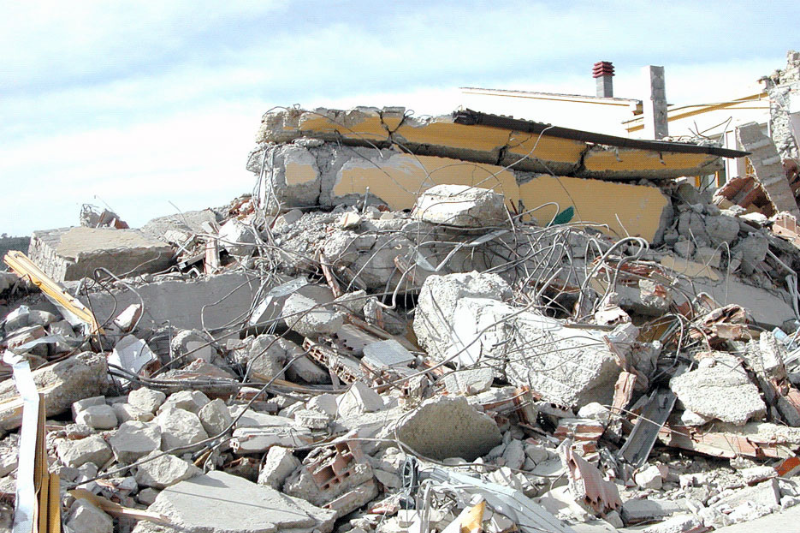
On October 31, 2002, a 5.7 magnitude (Mw) earthquake struck the lower Molise area. The earthquake, distinctly felt in several regions of central and southern Italy, particularly affected the municipalities of Santa Croce di Magliano, S. Giuliano di Puglia, and Larino, in the province of Campobasso.
The most dramatic events occurred in San Giuliano di Puglia, where the earthquake caused the collapse of the roof slab of the "Francesco Jovine" school building, causing the death of 27 children and a teacher. The tragedy caused an enormous shock all over the country but stimulated a deep discussion among the scientific community about the criteria of the current seismic classification. So far, no significant earthquakes had ever been recorded in the area affected by the earthquake, and the majority of the localities involved were not seismically classified.
A new seismic classification. Following these considerations, the work of the scientific community immediately focused on the development of a new classification by assessing the probability that each territory could be affected in a certain time interval (usually 50 years) by an event exceeding a certain threshold of intensity or magnitude.
The result of this work leads to the issuance of Ordinance No. 3274 in 2003: the national territory - previously classified into three categories of different severity - is divided into four zones of degressive dangerousness. Thereby, the territories previously considered to have limited seismic stress, and therefore unclassified, are placed in "zone 4" where the regions have the authority to require mandatory earthquake-resistant design. Each zone is also assigned a value of seismic action useful for design, expressed in terms of maximum acceleration in the rock layer.
In terms of structural prevention, other measures have been taken, such as the review by ownership bodies of buildings that are strategic and relevant for civil protection purposes, including schools, and the obligation to construct, structurally and anti-seismically retrofit existing buildings according to the expected stresses in the event of an earthquake.
A webinar, to not forget. The new seismic classification, the importance of structural prevention actions, and the commitment to make school buildings increasingly safe were also the focus of the webinar "S. Giuliano di Puglia, 20 years later." The meeting, moderated by Angelo Masi, professor of Construction Technology at the University of Basilicata, was attended by Professor Mauro Dolce, Public Works Councillor for the Region of Calabria; Carlo Meletti, geologist and chief technologist at the Ingv-National Institute of Geophysics and Volcanology; and Adriana Bizzarri, national school coordinator for Cittadinanzattiva.
The webinar-which is part of a series of digital meetings focused on the themes of prevention and spreading the culture of civil protection is available on the I don't take risks YouTube channel at the link: https://www.youtube.com/watch?v=6v-nBvyYXmE
Photo source: INGV website